
In this blog post I want to go just a little bit beyond the basics of traditional IRAs and how they work.
What Are Traditional IRAs?
An IRA is an individual retirement account by definition, with the emphasis on individual. One IRA means one owner — there can be no joint titling. In order to contribute to an IRA you must have earned income: wages, salaries, tips, and separate maintenance payments. Investment income from capital gains, dividends, and interest does not count as earned income. Note: for divorce agreements executed prior to January 1, 2019, alimony also counts as earned income; post-2018 agreements do not, per the Tax Cuts and Jobs Act.
How Much Can I Contribute?
Your contribution limit is $7,500 per year (2026). If you’re 50 or older, an additional $1,100 catch-up contribution is allowed, bringing the total to $8,600. The age restriction on Traditional IRA contributions was repealed by the SECURE Act of 2019, so as long as you have earned income you can contribute at any age.
What’s the Big Deal?
The big deal about traditional IRAs is that you may be able to deduct the contribution from your federal taxes. Say you’re in a 24% tax bracket and you make a $7,500 IRA contribution. You’ve saved yourself $1,800 in federal taxes. Another way to look at it: the $7,500 IRA contribution only cost you $5,700. This is a great deal! That $1,800 was going to leave your checking account one way or another – at least this way it remains with you.
This is in contrast to a Roth IRA, which works the opposite way tax-wise. You do not deduct contributions on the way in, but when it comes out in retirement — it is all tax-free.
Can I Deduct My Contributions?
Perhaps. Traditional IRA contributions are fully deductible if you were not an active participant in an employer plan. Active participation means that anything — even one dollar — went into your account during the tax year. Even if the employer made no contributions, but there were forfeitures allocated to your account, you had active participation.
You may also be able to do a spousal IRA: only one spouse works, but the working spouse can fund both IRAs. Both contributions will be deductible if neither has active participation.
What if I Do Have Active Participation?
If you are covered under an employer’s plan, there is an income phase-out for IRA deductibility. For 2026:
- Single / Head of Household (covered by employer plan): Full deductibility below $81,000; phase-out from $81,000 to $91,000; no deduction above $91,000
- Married Filing Jointly (contributing spouse covered): Full deductibility below $129,000; phase-out from $129,000 to $149,000; no deduction above $149,000
- Married Filing Jointly (contributing spouse NOT covered, but other spouse is): Full deductibility below $242,000; phase-out from $242,000 to $252,000; no deduction above $252,000
- Married Filing Separately (active participant): Phase-out begins at $0 and ends at $10,000 — very limited deductibility
Anyone Can Do a Non-Deductible IRA
What if I’m phased out by income? Every taxpayer can make a non-deductible IRA contribution as long as they have earned income. Since withdrawals will be part return of contributions (not taxed) and part earnings (fully taxable), meticulous records must be kept. If you have some IRA contributions that were deductible and some that were not, keep them in two separate accounts so the tax accounting is easier.
What Are My Investment Choices?
You can invest Traditional IRAs in financial assets — bank accounts, stocks, bonds, mutual funds, ETFs, UITs, real estate investment trusts, and annuities. Life insurance, works of art and collectibles, real estate, and precious metals are generally prohibited, with the exception of certain gold coins. There is such a thing as a self-directed IRA that can hold some of these assets, but that is beyond the scope of today’s discussion. The account owner cannot use margin to purchase securities, and most brokerage firms will not allow most options trading in an IRA.
Please don’t confuse prohibited investments with prohibited transactions. The latter term describes the self-dealing rules — you cannot personally sell an asset into your IRA, nor buy it out. That is a topic for another day.
When Do I Get Taxed?
When you withdraw the money down the road, you are taxed then as ordinary income — as opposed to capital gains. If you bought a stock at $100 and sold it for $120, you have a $20 capital gain, taxed at 0%, 15%, or 20% depending on your income. For most taxpayers it will be 15%. Ordinary income is taxed at your marginal rate. See the trade-off? The upside is the tax deduction now and deferral of taxation on all gains within the IRA. The downside is that you’ve exchanged the more favorable capital gains rates for ordinary income tax rates at withdrawal time.
Big Warning!
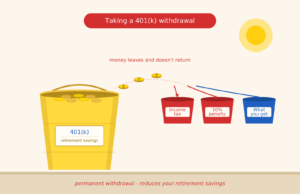
One more big caveat: if you’re withdrawing before age 59½, you have a 10% penalty on the amount withdrawn. Say you are age 50 and you want to get your hands on $10,000 quickly, so you withdraw $10,000 from your IRA. What are the tax consequences? In a 24% bracket, $2,400 is the tax. Because you are below 59½ there’s also a 10% penalty — another $1,000. You are only going to net $6,600 on a $10,000 withdrawal.
What’s the strategy for distributions? First, realize that this money shouldn’t be touched until 59½ at a minimum. Then, manage the distributions in a way that doesn’t push you into the next marginal tax bracket. Required minimum distributions are another issue, addressed separately.
For more information see these blog posts: