What is a Roth IRA?
One of the most popular ways to save for retirement is in a Roth Individual Retirement Account, or a Roth IRA. Roth IRAs first came out in 1997 after being championed by former Senator William V. Roth of Delaware. Tax-wise, a Roth IRA works like a Traditional IRA but backwards. In a Traditional IRA, just like 401ks, you generally get an up-front tax deduction when making a contribution. The account grows tax-free over time. At retirement whatever you take out of a Traditional IRA is taxable at your ordinary income rate as you withdraw it.
If in retirement your tax bracket is 22% and you distribute $1000 from your Traditional IRA you will get to keep $780. The IRS gets $220. Remember, since contributions are made before tax, distributions from a Traditional IRA are fully taxable.
The Roth IRA basically works the other way around. In a Roth IRA, or Roth 401k, you get no tax deductions up front when contributing. The growth within the Roth IRA is tax-deferred, just as in the traditional IRA. You can invest in stocks, bonds, mutual funds, exchange-traded funds (ETFs), and other investment vehicles. But when you retire and need income from a Roth, all your distributions — earnings plus contributions — come out tax-free!
Let’s do the same example, but from a Roth. You’re in the same 22% tax bracket, and you distribute $1000 from your Roth IRA. You receive the entire $1000 without a tax haircut from Uncle Sam.
This is the best deal out there!
If you’ve been saving money over several decades, think of how much of your hard-earned cash you’ll be able to keep just by proactively saving into a Roth IRA now. On the flip side, think of how much more you’ll need to save or earn within a Traditional IRA just to be able to access the same amount in retirement within a Roth IRA.
How much can I contribute?
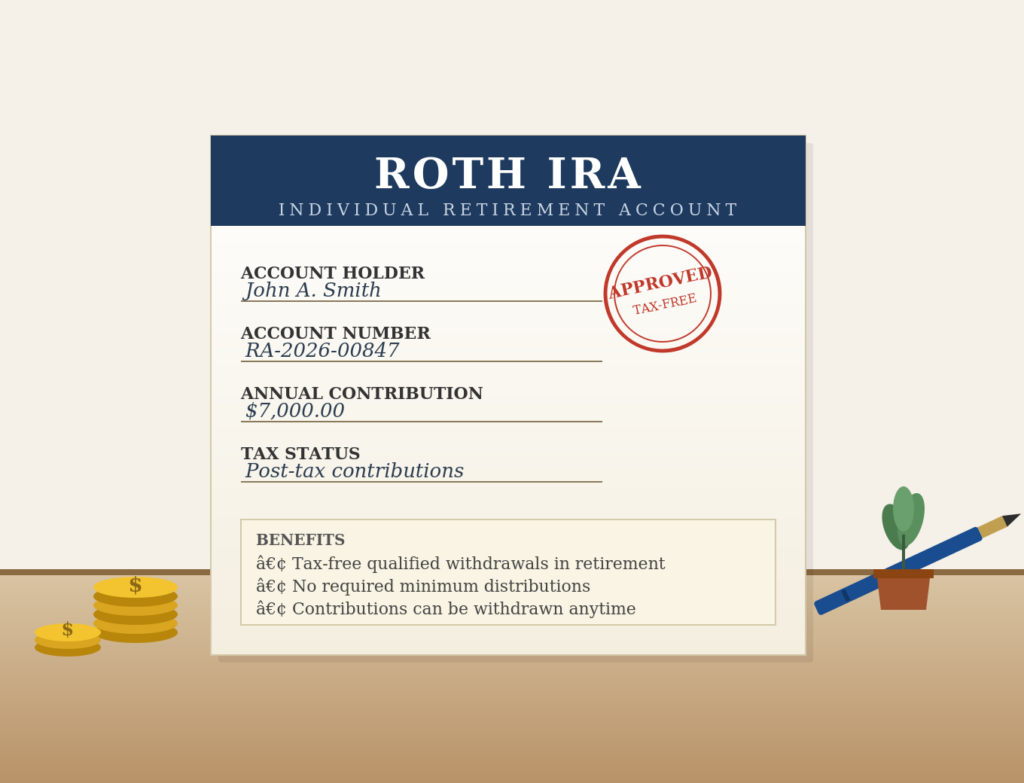
You can contribute up to $7,000 into a Roth this year (2026). If you’re over 50, the IRS lets you contribute an additional $1,000, for a total of $8,000. These contributions are after-tax, so you’ll get no tax deduction going in.
Your contributions can be withdrawn at any time and at any age with no taxable event. Earnings, however, are fully taxable and subject to a 10% penalty before age 59½. After that – the entire account can be distributed with no taxes. You can almost think of your Roth as a backup emergency fund.
For Roth conversion amounts, there is a 5-year holding period rule, among other factors, so a Roth isn’t for short term investing.
Who should have one?
The younger you are the stronger the argument for a Roth. The higher your tax bracket, the stronger the argument for a traditional (deductible) IRA. As CERTIFIED FINANCIAL PLANNER™ practitioners, this is exactly the kind of analysis we do on our client’s behalf.
Who is eligible to contribute?
There are a few eligibility rules: First, you need to have earned income to participate – that is, taxable income that you earned in the current calendar year. Investment earnings and Social Security payments are not earned income in this context. Second, high earners cannot contribute to a Roth. If you make more than $150,000 as a single person and more than $236,000 as a married person (2026), you are subject to phaseout rules. Once your income exceeds phaseout limits, you can no longer contribute directly to a Roth. There are ways around this with Roth conversions, but that’s a topic we cover in another blog entry.
If you file taxes as married filing separately, you’re completely phased out of Roth contributions at the $10,000 taxable income level, which means essentially that you can’t do it.
Why should I have a Roth?
For the huge potential tax savings!
Imagine being retired at age 67, with 30 years of life still ahead of you, and having a tax-free stream of income that entire time! Read on for more information: Two Things You Need to Know about the Roth IRA, and Roth Conversions.
!